

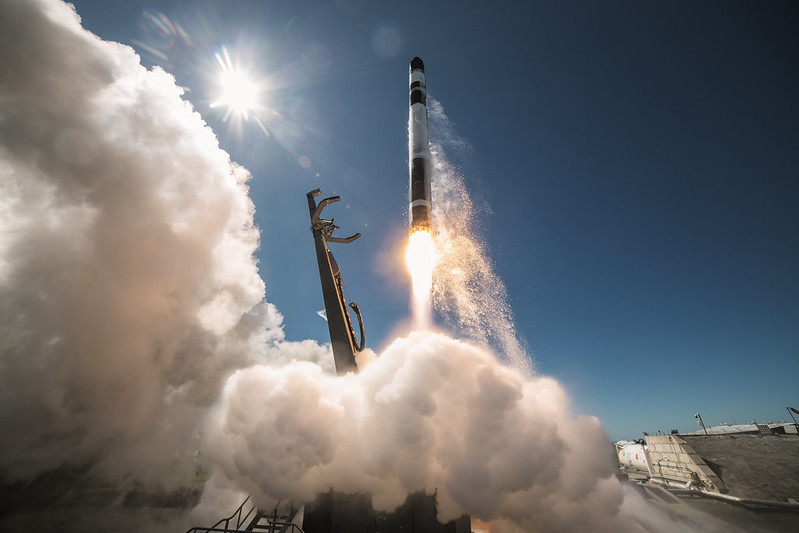
Rocket Lab announced on 30 September 2026 that it has signed an agreement with Japanese radar imaging company Synspective for 20 additional dedicated Electron launches, which the company described as the largest commercial Electron agreement it has ever signed. The new order brings the total number of missions Rocket Lab has agreed to fly for Synspective to 47, making Synspective the most frequently flown customer in Rocket Lab’s history. Under the agreement, the new missions are scheduled to launch annually from 2028 through 2031, according to the companies’ joint announcement.
Synspective operates the StriX constellation, a group of synthetic aperture radar satellites that use radar rather than optical cameras to image the ground, allowing the satellites to capture images of any location on Earth within hours regardless of cloud cover, darkness or weather conditions. Rocket Lab has already launched StriX satellites for Synspective on a series of Electron missions, most recently deploying the company’s twelfth StriX satellite on the 97th Electron mission from Rocket Lab’s Launch Complex 1 in New Zealand on 26 September 2026, placing the spacecraft into a 559 kilometer (347 mile) low Earth orbit. Neither company disclosed the financial value of the newly signed 20 launch agreement.
Sir Peter Beck, Rocket Lab’s founder and chief executive, said that constellation builders seeking control over their own deployment schedule increasingly turn to Rocket Lab, and that signing 20 launches in a single agreement reflected confidence not only in the Electron vehicle itself but in Rocket Lab’s launch cadence, mission reliability and orbital precision. Synspective chief executive Motoyuki Arai said Electron’s precision and reliability had played a central role in steadily scaling the StriX constellation, and that securing another 20 dedicated launches gave the company long term certainty as it continues expanding.
The agreement underscores a business model that depends on dedicated small satellite launches delivering spacecraft to precise, customer specified orbits rather than sharing a single rocket among many customers through rideshare missions. Synspective’s radar satellites are used for applications including disaster response, infrastructure monitoring, maritime surveillance and other situations where repeated, reliable imaging regardless of lighting or weather matters more than the lowest possible cost per kilogram. For Rocket Lab, a multi year, multi launch commitment of this size provides revenue visibility stretching out to 2031, at a time when the company is also working to bring its larger Neutron rocket into service.
Rocket Lab’s broader business has expanded well beyond Electron in 2026. The company is simultaneously developing Neutron, a larger, partially reusable rocket intended to carry heavier payloads including national security and commercial satellites, and in September 2026 it also moved forward with its proposed acquisition of satellite operator Iridium Communications, a deal shareholders approved by an overwhelming margin on 24 September 2026. Electron itself has now flown 97 missions, the New Zealand based program having grown from a dedicated small satellite launcher into one leg of a company that increasingly builds, owns and operates satellite hardware as well as launching it for others.
Some details of the new Synspective agreement remain unclear. Rocket Lab has not disclosed the contract’s total value, nor specified which Electron launch sites, whether in New Zealand or at Rocket Lab’s Virginia facility, will host the new missions. The companies have also not said whether any of the 20 new launches will carry upgraded StriX satellites with different specifications from those already in orbit, or whether the agreement includes options for additional launches beyond 2031. As with any multi year agreement spanning several years, execution risk remains, including whether Rocket Lab can sustain its current launch cadence and reliability record across dozens of additional missions without the kind of delay or anomaly that has affected other vehicles in the industry this year.