

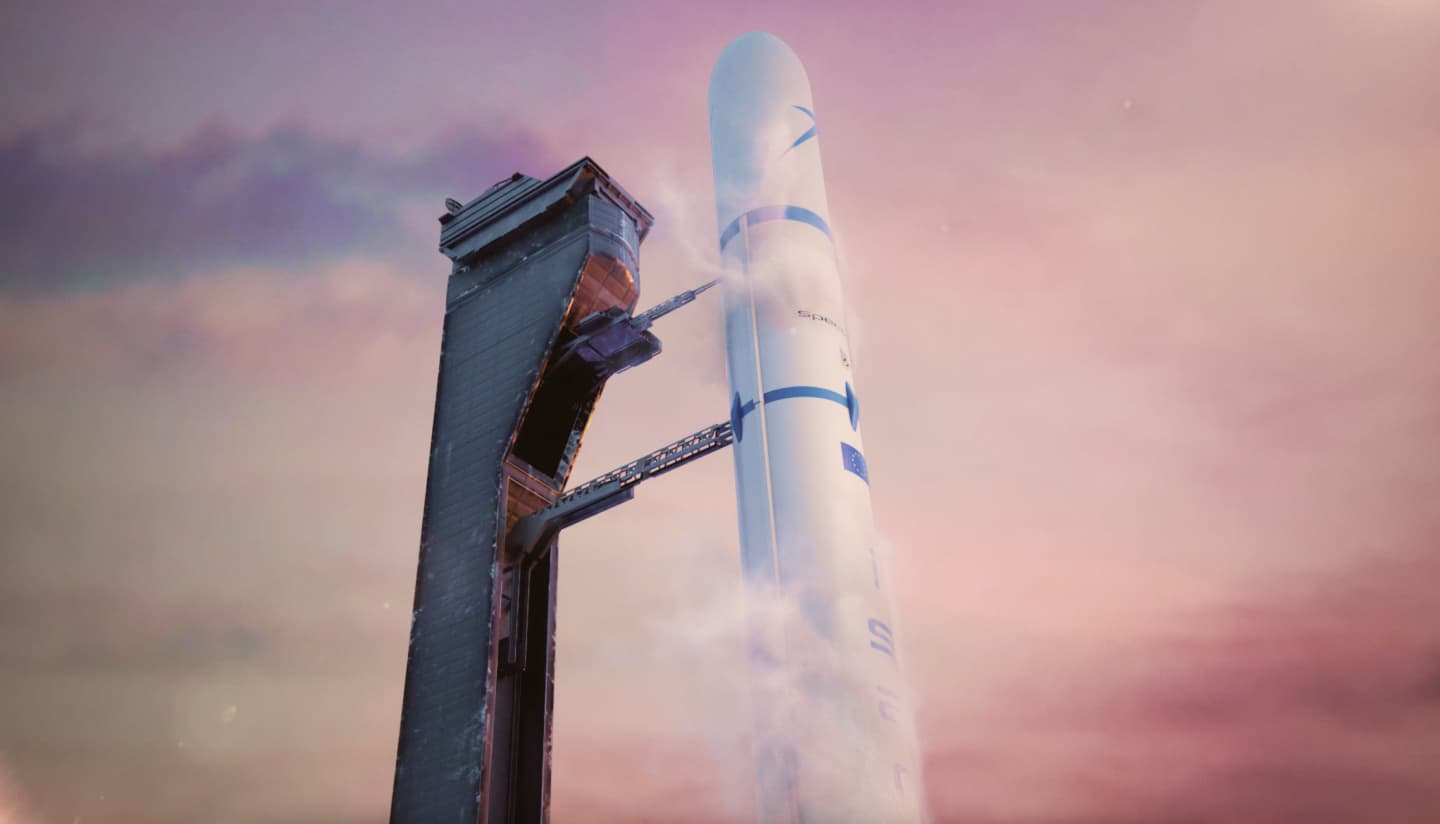
Isar Aerospace, the German launch vehicle developer, announced on 15 September 2026 that it had signed a new agreement with the American company SEOPS for five additional rideshare missions, extending the pair’s partnership to six missions in total and marking the company’s first wave of confirmed commercial bookings since its Spectrum rocket reached orbit for the first time earlier this month. The new missions are planned for 2028 to 2030 and will fly from Andoya Space in Norway and the planned Spaceport Nova Scotia in Canada, though neither company has disclosed the value of the agreement or named the satellites involved.
The bookings follow Spectrum’s second flight, which lifted off from Andoya Spaceport on 5 September 2026 at 20:12 UTC carrying five commercial and educational CubeSats. The rocket completed stage separation, upper stage ignition and fairing deployment before a circularization burn released its payloads into low Earth orbit at 10:14 UTC the following day, the first time a privately funded, orbital class rocket had reached orbit from continental Europe. Spectrum stands 28 metres tall and 2 metres in diameter, is powered by ten engines, and is designed to carry up to 1000 kilograms to low Earth orbit. The flight followed four earlier attempts that were scrubbed or ended early during 2026 because of a pressurization valve issue, poor weather combined with an unauthorized boat in the exclusion zone, a leaking composite overwrapped pressure vessel, and off nominal behavior in the rocket’s fluid systems. Isar Aerospace, founded in Munich in 2018, now employs more than 400 people across five locations and says its planned new headquarters will be capable of producing up to 40 Spectrum rockets a year.
The commercial momentum builds on government support the company secured earlier in the year. On 27 August 2026, the European Space Agency signed contracts worth roughly 200 million euros, or about 232 million dollars, with Isar Aerospace under its European Launcher Challenge program, alongside similar agreements worth 186.9 million euros with Rocket Factory Augsburg and 158.9 million euros with Spain’s PLD Space. The program is ESA’s mechanism for supporting several competing commercial launch providers rather than concentrating funding in a single vehicle the way the agency has historically done with Ariane. Isar’s chief commercial officer, Stella Guillen, said at the time that Europe was putting serious resources behind its own access to space, while ESA’s director of space transportation, Geraldine Naja, said the contracts were meant to encourage competition among European launch providers and that it was now up to the companies to prove they could deliver. Isar went on to become the first of the three challengers to reach orbit with its 5 September flight. On the SEOPS deal, Guillen said signing a second contract with the company was a strong vote of confidence in what Isar is building, and SEOPS president Evan Hoyt said Isar had accomplished what very few companies ever do by building a new launch system and successfully reaching orbit.
Together, the events matter because Europe has for years depended on Arianespace’s Ariane 6, on Russian vehicles it can no longer use after 2022, or on American providers including SpaceX to reach orbit, without a privately funded domestic alternative of its own. Isar’s successful flight, the government funding that preceded it, and the commercial bookings that have followed give European governments and international customers a second working domestic launch option alongside Ariane 6, and put pressure on Rocket Factory Augsburg, PLD Space and MaiaSpace, whose own European Launcher Challenge contract was still being finalized as of late August, to demonstrate similar progress. SEOPS, which manages dedicated rideshare capacity for satellite operators through its Waymaker program, is a United States company, meaning its expanded bookings also show non European customers are willing to commit to multiple future flights on Spectrum well before the vehicle has an extended track record.
Several details remain unresolved. Neither company has disclosed the financial terms of the SEOPS agreement or which specific satellites it will carry, and Isar has not said which upcoming Spectrum flight will be its first fully commercial mission rather than a qualification or demonstration launch. It is also unclear how quickly the company can move from occasional test flights to the annual cadence its planned factory is designed to support, and ESA has not published an updated timeline for when Rocket Factory Augsburg, PLD Space or MaiaSpace are expected to reach orbit under the same challenge.