

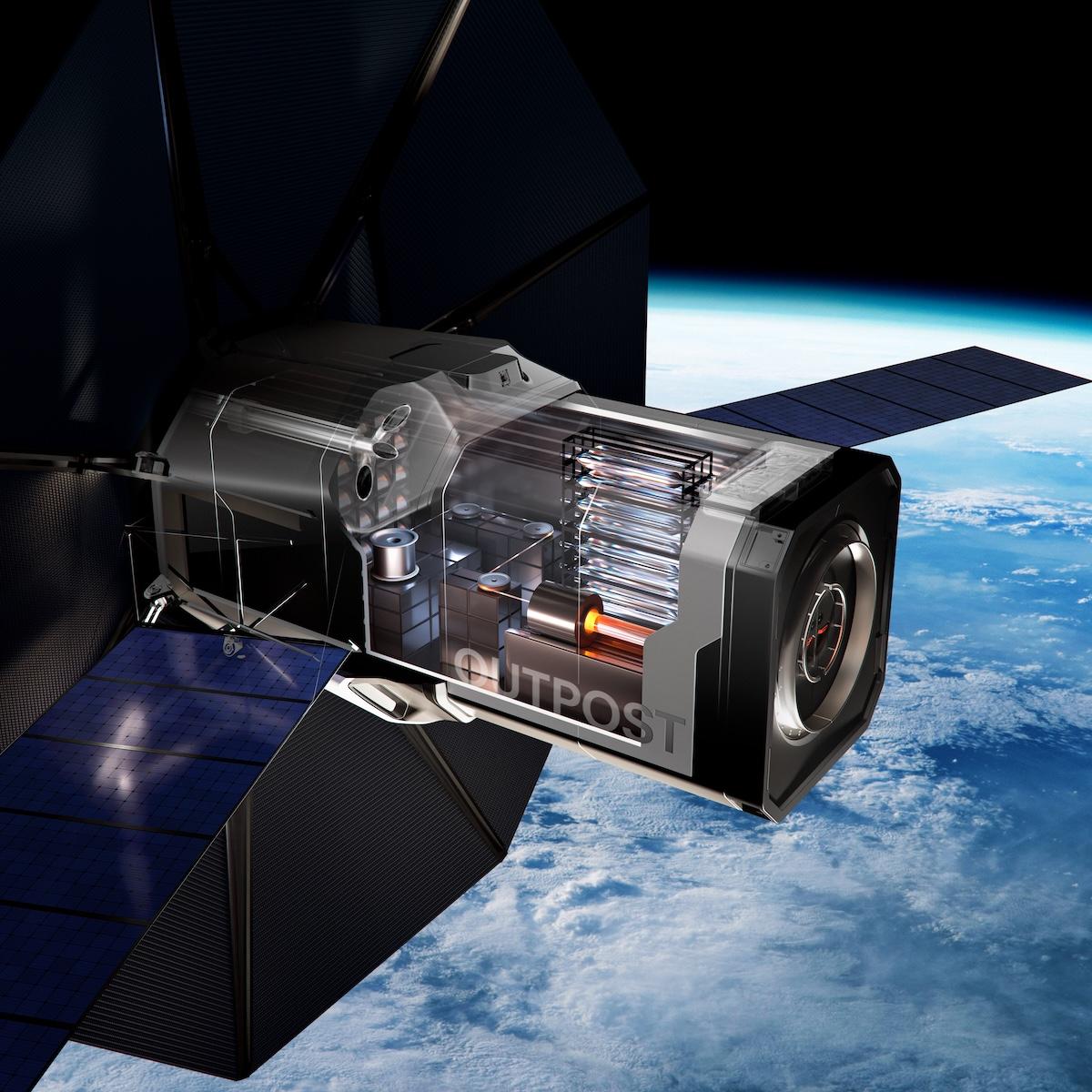
Outpost Technologies Corporation introduced a commercial service on 24 September 2026 that lets companies manufacture products in orbit and return them to Earth without building their own spacecraft, launch capability or reentry systems. The service, called Space Factories, is aimed at industries that need the conditions found only in microgravity, such as certain optical materials, pharmaceuticals, biotechnology products, semiconductors and crystals, and packages the entire supply chain, from launch to orbital production to landing, as something a customer can simply buy access to.
The offering rests on three pieces of hardware. Outpost’s CarryAll spacecraft, which the company has previously described as capable of returning payloads of up to 10,000 kilograms and landing within about 10 meters of a target site anywhere on Earth, provides transport to and from orbit along with power and communications. A Space Factory container, built to be housed inside CarryAll, handles production, pressurization, thermal control and safety interfaces for whatever process is running inside it. A third, customer specific manufacturing module is fitted to each client’s particular process. In a statement announcing the service, Outpost’s president said the company is building “the hard, expensive infrastructure: the vehicle, the power and thermal systems, standardized manufacturing modules, the reentry and recovery,” and operating all of it as a service so customers do not have to.
Outpost is demonstrating the concept with its own product first. The company said it is manufacturing StarFiber, a metal fluoride optical fiber designed to carry signals with less loss than conventional fiber and to hold up better under radiation, properties that make it useful for satellite systems and defense applications. Metal fluoride fibers are difficult to produce with high quality on Earth because gravity driven convection and container contact during processing introduce defects, and orbital manufacturing companies have argued for years that microgravity production could sidestep those problems.
The announcement did not include a customer list, a price for the service, funding figures tied to Space Factories specifically or a launch date for the first paying mission. Outpost said only that it was inviting manufacturers interested in optical materials, pharmaceuticals, biotechnology, semiconductors or crystal growth to contact its sales team, an approach that leaves the commercial scale of the offering, for now, undemonstrated.
The move places Outpost inside a small but growing group of companies betting that manufacturing in orbit can become a real industrial category rather than a research novelty. Earlier ventures in the field have focused on similar microgravity advantages, chiefly the near absence of gravity driven convection and sedimentation, to justify producing pharmaceuticals, semiconductor materials and optical products that are harder or impossible to make with equivalent quality on Earth. What has generally limited the field is not the manufacturing step itself but the cost and reliability of getting hardware into orbit and, just as importantly, bringing finished product back down intact. By packaging return capability as part of the service rather than leaving it to the customer, Outpost is betting that reentry and recovery, not orbital production, has been the harder problem for the industry to solve.
Whether that bet pays off will depend on facts the announcement does not yet provide. There is no public information on how much a customer would pay to use Space Factories, how long a typical production run would take from launch to delivery of finished material back on Earth, or which specific companies, if any, have committed to using the service beyond Outpost’s own StarFiber line. It is also unclear how Space Factories production volumes would compare with what ground based manufacturing can already achieve for the same materials, a comparison that will ultimately determine whether orbital manufacturing is a genuine commercial opportunity or remains a boutique source of specialty material. Outpost has said it plans further disclosures as it signs customers, which should make it possible to judge the service against those questions over the coming months.