

China sent four different rockets into orbit within 45 hours on 15 and 16 September 2026, launching from three separate sites and mixing commercial and state operators in a display of launch tempo that industry watchers say underscores how much capacity the country has added to its space program in a short span of time. The sequence began with LandSpace’s Zhuque 2E rocket lifting off from the Jiuquan Satellite Launch Center in the Gobi Desert on 15 September carrying 10 satellites for the Qianfan broadband constellation, also known as Spacesail.
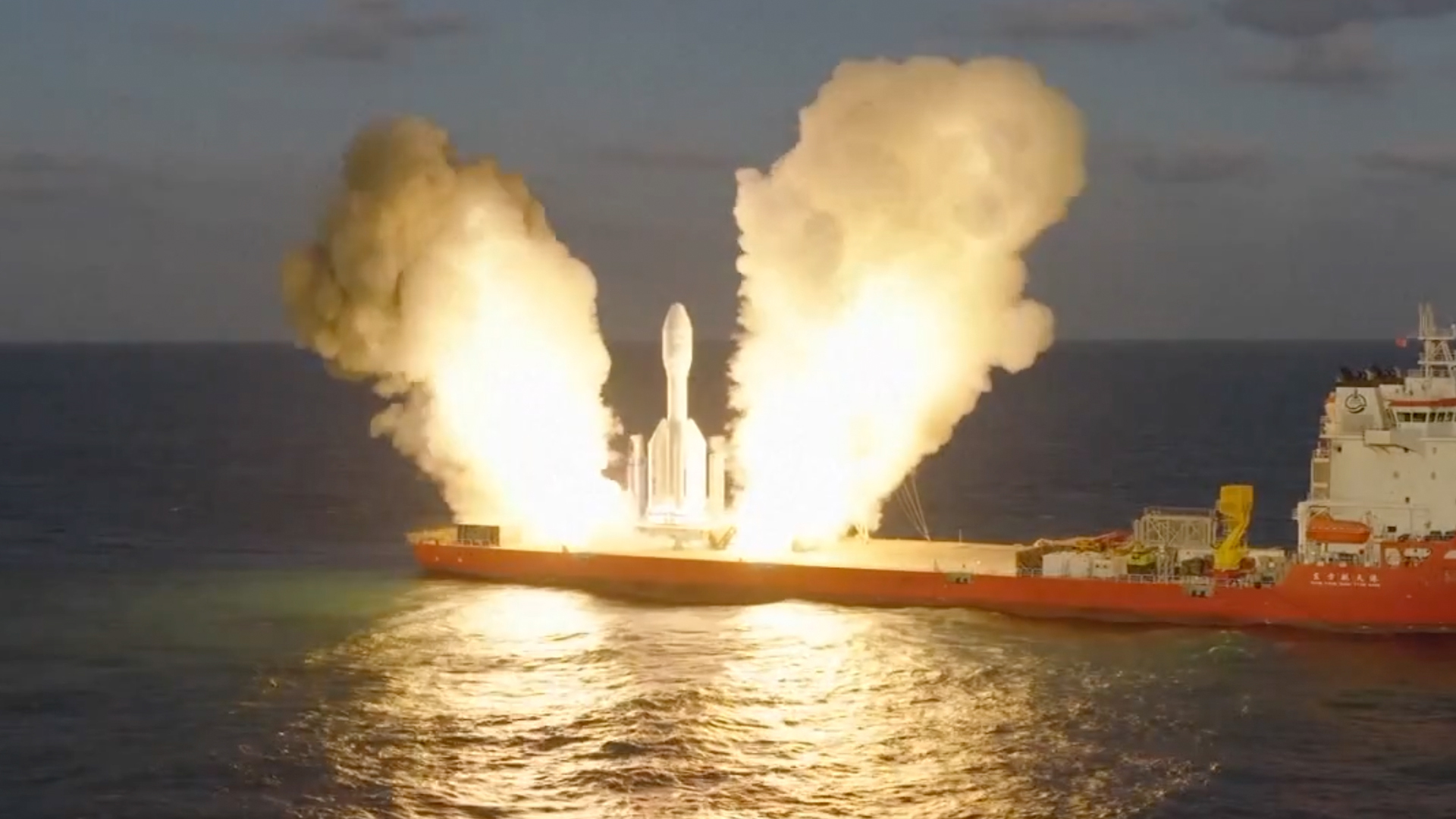
Roughly 16 hours later, Orienspace’s Gravity 1 rocket launched from a sea based platform in the East China Sea off Shanghai, carrying 8 more Qianfan satellites plus one experimental high speed communications test spacecraft. The following day, the state operated China Aerospace Science and Technology Corporation launched a Long March 12 rocket from the Wenchang Commercial Launch Site on Hainan island carrying 9 satellites for the rival Guowang broadband constellation, run by the state backed China SatNet. The spree closed with a Kuaizhou 11 rocket, built by a subsidiary of the China Aerospace Science and Industry Corporation, lifting off from Jiuquan with two Earth observing radar satellites for the Chinese company Spacety.
Reporting on the dual Zhuque 2E and Gravity 1 launches described them as the first time Chinese commercial rockets had been used to network satellites into the Qianfan constellation as a batch, a step beyond simply placing individual satellites into orbit. Qianfan is planned to eventually include about 15,000 satellites, while Guowang, the state backed competitor that received its own satellites in this same window aboard the Long March 12, is planned to reach roughly 13,000. Both figures are targets set by the operators themselves and have not been independently verified. Taken together, the four launches show two separate Chinese megaconstellation programs being built out simultaneously, using a mix of vehicles from an established state contractor and newer commercial entrants that have only begun regular orbital launches in recent years.
None of the four missions in this particular sequence involved a booster recovery attempt, and all four rockets flew in expendable configuration. That stands in contrast to separate recent milestones elsewhere in China’s launch sector, where LandSpace’s larger Zhuque 3 vehicle and a variant of the state operated Long March 10 have each completed first stage recovery demonstrations, suggesting reusable launch technology is progressing in China on a track that runs parallel to, rather than through, the high frequency constellation launches seen this week.
The broader context is a race between China’s two large satellite internet efforts and the well established Starlink network operated by SpaceX, along with Amazon’s Leo constellation, both of which have been expanding rapidly. Qianfan is backed by a Shanghai municipal government linked company, while Guowang is organized under the central government owned China SatNet. Analysts have noted that the existence of two competing state linked broadband megaconstellations, rather than one coordinated national effort, reflects overlapping industrial policy goals as much as pure commercial strategy, and that sustaining launch cadence at this level will require continued investment in both vehicle production and satellite manufacturing capacity.
What the four launches demonstrate most clearly is operational reach: three geographically distinct launch sites, a sea based platform among them, four distinct rocket families from four different manufacturers, and two different customer constellations, all executed inside a 48 hour window without a reported failure. Sustaining that pace across an entire year, rather than for a single high visibility stretch, remains the harder test, and neither megaconstellation has published a detailed public timeline showing how many further launches will be needed each month to hit its stated satellite targets. Independent tracking of on orbit satellite health for the newly launched spacecraft was not available at the time of writing, and it remains to be seen whether this cluster of launches was a one off scheduling coincidence timed around favorable weather and range availability or the start of a sustained higher cadence for China’s commercial launch sector.