

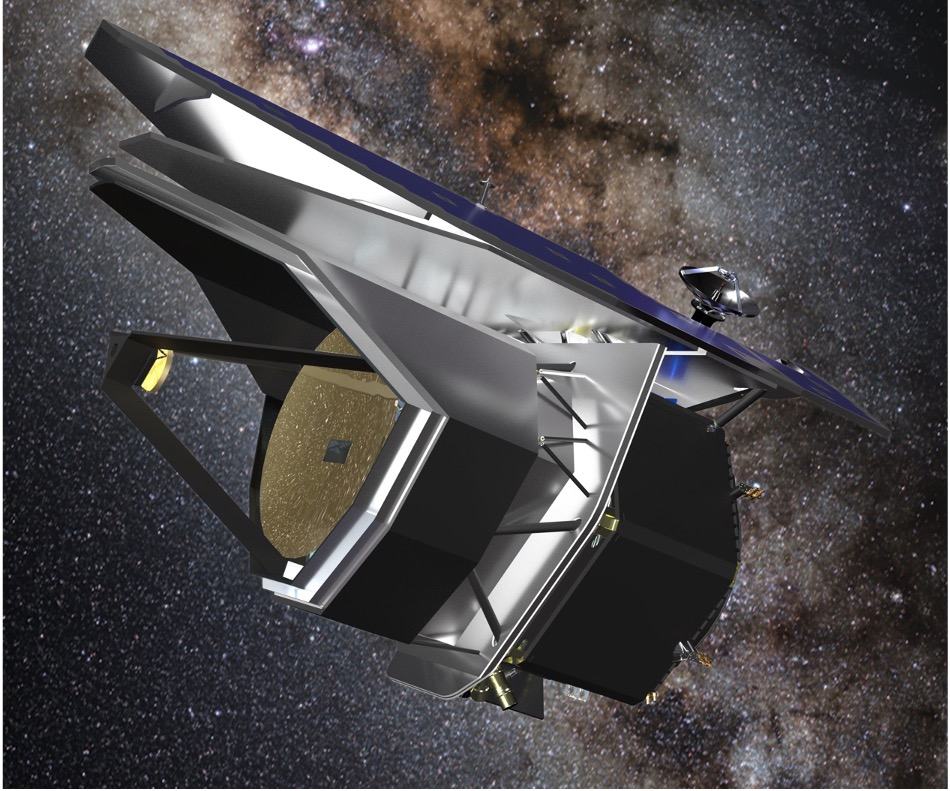
NASA announced on 24 September 2026 that it has selected the PRIMA far infrared space telescope as the first mission in a new class of astrophysics probes, clearing the project to move into Phase B, the detailed design stage that follows initial concept studies. The mission, whose name stands for PRobe far Infrared Mission for Astrophysics, is capped at 1.2 billion dollars in development cost, a figure that excludes the launch vehicle and mission operations. NASA has targeted a launch in 2033, with a planned operating life of about five years.
PRIMA is built around a 1.8 metre telescope cooled to cryogenic temperatures so it can observe faint far infrared light, at wavelengths between roughly 24 and 235 micrometres, without the telescope’s own heat overwhelming the signal. It carries two main instruments, an imaging polarimeter called PRIMAger and a high resolution spectrometer called FIRESS. Both rely on superconducting detectors known as microwave kinetic inductance detectors, a technology invented by Jonas Zmuidzinas and Rick LeDuc and first tested at the Caltech Submillimeter Observatory in 2007. NASA’s Jet Propulsion Laboratory will lead development and operation of the observatory, working with the agency’s Goddard and Marshall Space Flight Centers, while the Infrared Processing and Analysis Center at the California Institute of Technology will serve as the mission’s science centre, handling data processing and archiving. Roughly three quarters of PRIMA’s observing time is set aside for the broader astronomical community rather than the mission team, following the model NASA uses for other general purpose observatories.
Scientifically, PRIMA is intended to fill a gap in the electromagnetic spectrum that sits between the near and mid infrared view of the James Webb Space Telescope and the millimetre and radio wavelengths studied by ground based facilities such as the Atacama Large Millimeter Array. NASA describes the mission’s goals as probing the origins of planets around other stars, tracing how galaxies and the supermassive black holes at their centres have grown across cosmic history, and following how dust and heavy elements have built up over time. Nicky Fox, who leads NASA’s Science Mission Directorate, said in the agency’s announcement that the “PRIMA mission is humanity’s next window into the deep universe” and that it “will unveil the obscure across cosmic time.”
The mission also has a substantial international component, with the space agencies of France, Italy, Germany, Canada, South Korea, Japan and the United Kingdom all named as partners contributing to the project. Far infrared astronomy has been comparatively underserved since the European Space Agency’s Herschel Space Observatory, a 3.5 metre telescope that also relied on liquid helium cooling, exhausted its coolant supply on 29 April 2013 after more than three years of observations at wavelengths from 55 to 670 micrometres. NASA and its partners have argued that the intervening years of detector development, including the kinetic inductance sensors PRIMA will use, should allow the new mission to observe with far greater sensitivity than earlier far infrared instruments.
A number of details remain to be settled. NASA’s announcement did not name a launch vehicle for PRIMA, and given the 2033 target date, that decision is unlikely to be finalised for some time. The 1.2 billion dollar cost figure is described as a cap on development spending rather than a final total mission cost, since it does not include launch or operations, so the full lifetime cost of the mission will be higher and will only become clear as the project proceeds through design reviews over the coming years. NASA has also not yet detailed the full instrument team or specified how observing time will be allocated among the international partner agencies. Phase B is expected to last several years before the mission moves into fabrication and testing, meaning PRIMA’s final design could still evolve considerably before it is ready to fly.