

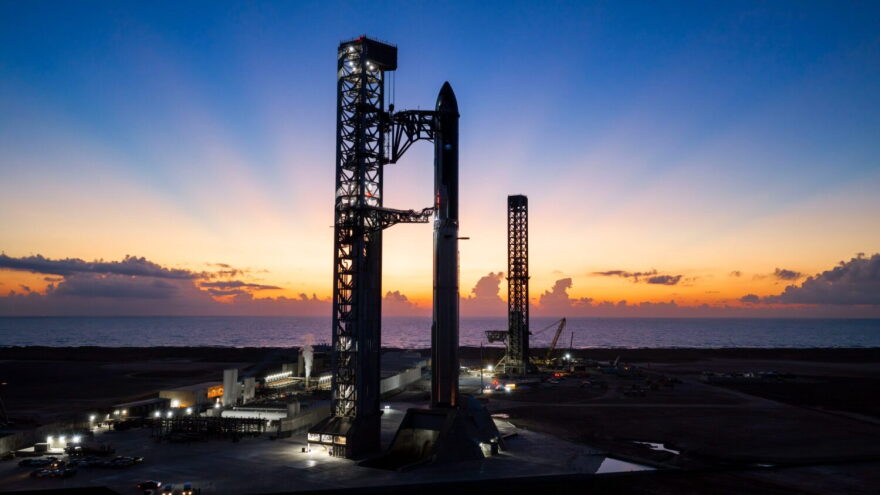
SpaceX has assembled its Starship rocket for the first time as a complete orbital vehicle, stacking the Ship 41 upper stage on top of the Booster 21 first stage at Starbase in South Texas early on 23 September 2026. The rollout began around 7:45 p.m. Central time the previous evening, and the two halves of the vehicle were joined roughly five and a half hours later. The combined rocket stands about 124 metres tall, with the 52 metre Ship 41 sitting atop Booster 21 to form the tallest and most powerful launch vehicle SpaceX has flown.
The mission, known internally as Starship’s fourteenth flight test, is described by company watchers as the vehicle’s first ever attempt at a genuine orbital flight rather than the long suborbital arcs flown on the previous thirteen tests. SpaceX has set a launch window opening at 7:15 a.m. Central time on Monday 28 September 2026, with additional opportunities running through 4 October. Ship 41 is expected to carry 26 next generation Version 3 Starlink satellites, marking the first time SpaceX has attempted to deploy an operational payload from Starship rather than a dummy mass simulator. Under the mission profile, the ship would reach orbit and coast for close to eight hours before a targeted splashdown roughly nine hours and fifty minutes after liftoff, with primary and contingency zones set in the Indian Ocean and the South and Central Pacific.
Before launch, SpaceX planned a wet dress rehearsal, a full fuelling test of the stacked rocket, no earlier than 24 September, the first such test since an earlier flight in the program. Engineers also added a new liquid oxygen reclaim line to the launch tower, designed to eliminate the venting of leftover propellant during the final chilldown before launch by routing it back into storage tanks instead. The change is meant to reduce wear on tower hardware caused by cryogenic propellant spilling onto structures below the vehicle. Because the flight plan calls for new splashdown locations and a revised trajectory, SpaceX needed the Federal Aviation Administration to update its launch licence before flying. The agency also established a temporary flight restriction covering the airspace around Starbase up to 10,000 feet from 23 September through 7 October.
Starship is central to SpaceX’s long term ambitions, both as the vehicle NASA has selected to land astronauts on the Moon under the Artemis program and as the intended workhorse for future Mars missions and for launching the next generation of Starlink satellites at high volume. The vehicle’s combination of full reusability and a stainless steel airframe has made its development one of the most closely watched programs in the industry, and the current attempt follows a test campaign that has already spanned thirteen previous flights, each used to progressively expand what the vehicle could do and to gather data for the next iteration. A successful orbital flight carrying a working batch of satellites would be the clearest sign yet that the vehicle has moved from an experimental test article toward one capable of routine commercial service.
Even so, a great deal remains unresolved. SpaceX had originally aimed to launch earlier in the week before the schedule slipped to 28 September, and further delays are common for a program with this test history, so the date should be treated as provisional rather than fixed.
Neither SpaceX nor the FAA has said whether the wet dress rehearsal was completed successfully or what results it produced. It is also not yet confirmed whether the Starlink satellites aboard will be deployed into their operational orbit and begin service, or whether their deployment is itself considered part of the test rather than a guaranteed outcome. As of 26 September, the rocket had not yet flown, and whether this attempt succeeds in reaching orbit, deploying its payload and completing a controlled splashdown will not be known until the launch window opens.