

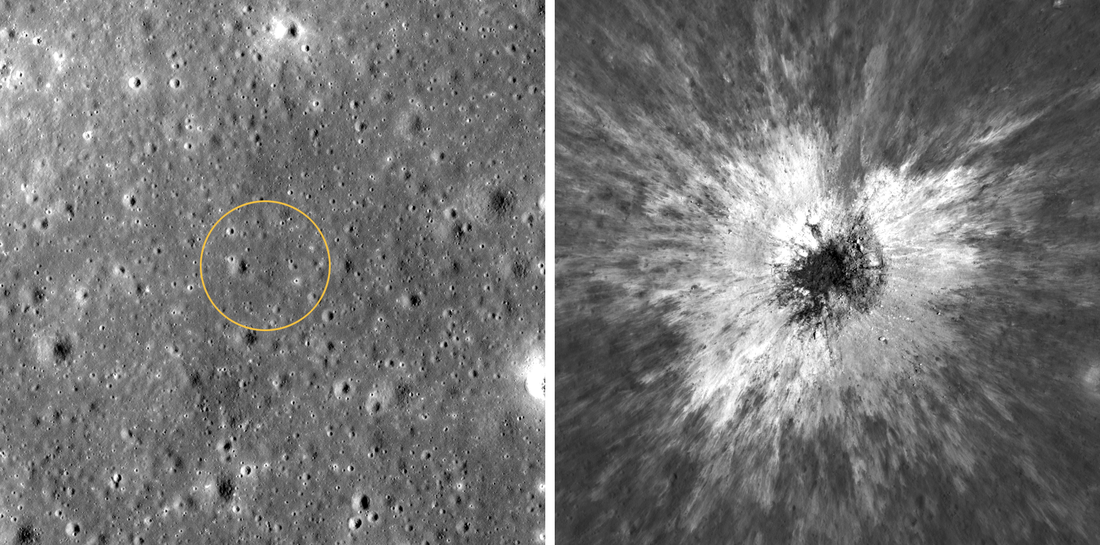
NASA’s Lunar Reconnaissance Orbiter has identified the largest newly formed impact crater yet found anywhere in the solar system, a discovery scientists say represents the kind of lunar impact expected only about once every hundred years. The crater, named McGetchin after lunar scientist Tom McGetchin, formed on the Moon’s eastern limb sometime between 11 April and 22 May 2024, near the boundary where dark basaltic mare terrain meets the brighter lunar highlands. Two papers describing the find were published on 15 and 16 September 2026 in the journal Science Advances, one led by the Lunar Reconnaissance Orbiter Camera team on the crater’s formation and debris field, and a second led by Tyler Powell using data from the orbiter’s Diviner Lunar Radiometer to examine the surrounding terrain’s thermal behavior.
The crater itself measures about 222 meters (728 feet) across and 43 meters (141 feet) deep, the product of an impactor NASA estimates was roughly the size of a three to six story building, likely a comet or asteroid fragment. It was spotted almost by accident. Robert Wagner, an image processing specialist working with Intuitive Machines, noticed it during a routine data quality check on 24 October 2025 while comparing Wide Angle Camera images of the same patch of terrain taken years apart. “It was by far the most obvious impact debris pattern I’ve ever seen in one of these images,” Wagner said, describing a bright halo and dark ejecta pattern radiating outward from the new scar that was unmistakable against older imagery of the same site. Once flagged, the orbiter’s Narrow Angle Camera was used to capture higher resolution follow up images, including an oblique view taken after the spacecraft rolled 51 degrees to bring the site into better lighting.
The most scientifically unusual result came from the Diviner instrument, which measures surface temperature. Around McGetchin crater, Diviner detected a “cold spot” spanning roughly 6.5 kilometers (4.3 miles) that runs about 16 degrees Fahrenheit (9 degrees Celsius) cooler than the surrounding terrain during the two week lunar night. Researchers attribute this to the impact churning up loose, fluffy regolith that holds less heat than the compacted material nearby, a signature that fades over time as the surface weathers and compacts again. “McGetchin crater is exceptional because it is the largest newly formed impact crater that has been identified to date,” Powell said of the find.
The discovery sits within a broader NASA program of monitoring the lunar surface for change. Since its launch in 2009, the Lunar Reconnaissance Orbiter has identified more than 1,000 new craters and flagged roughly 100,000 surface changes by repeatedly imaging the Moon and comparing results over time, work that has become increasingly relevant as multiple countries and private companies plan crewed and robotic landings in the coming years. A crater the size of McGetchin, forming without warning within a two year window, is a reminder that the lunar surface remains geologically active in the sense that it is still being reshaped by impacts, something planners of future surface missions and habitats have to account for even though the statistical odds of a similarly sized strike hitting any single planned landing site remain extremely low.
Much about the event remains unresolved. Researchers have narrowed the impact to a six week window based on the orbiter’s imaging schedule but cannot pin down the exact date, nor can they directly confirm whether the impactor was a comet or an asteroid fragment, since the object itself was destroyed on contact and its composition can only be inferred indirectly from the crater’s shape and the surrounding debris. It is also not yet known whether other impacts of comparable scale occurred elsewhere on the Moon during the same period but went undetected, since large stretches of the lunar surface are not imaged as frequently as the region where McGetchin was found. NASA has not announced plans for a dedicated follow up mission to the site, though the crater is expected to remain a reference case for studying how fresh impacts alter the thermal and physical properties of the lunar surface.