

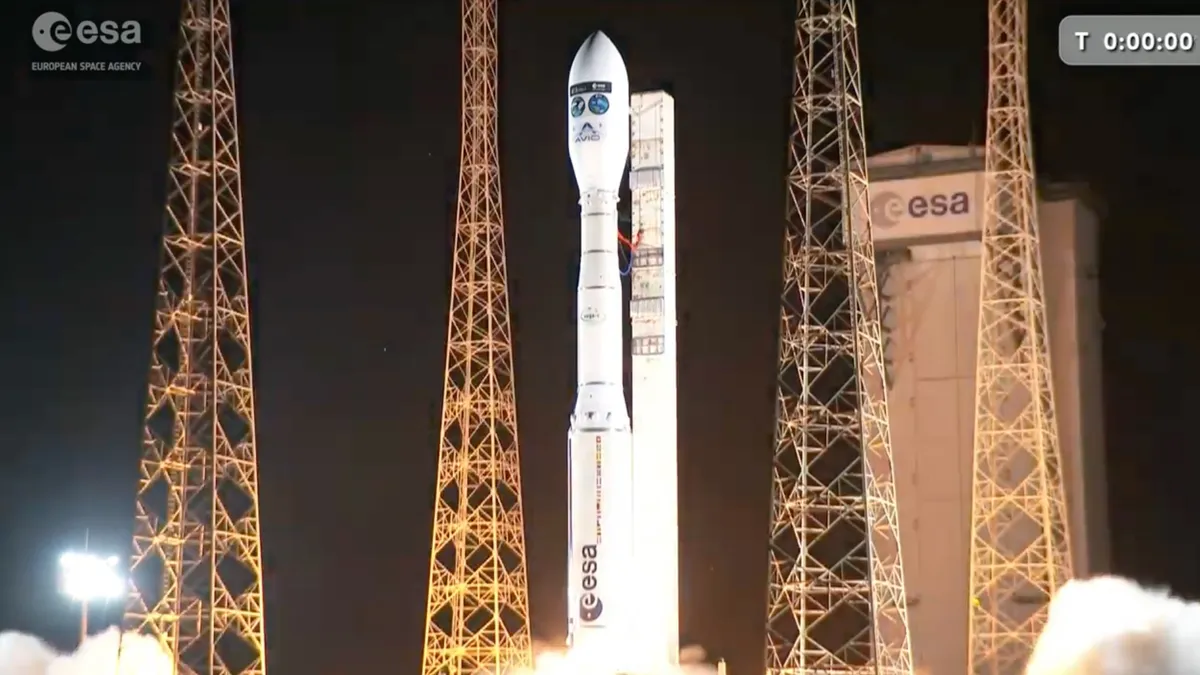
An Avio operated Vega C rocket lifted off from Europe’s Spaceport in Kourou, French Guiana, in the early hours of 15 September 2026, carrying two European Space Agency satellites designed to monitor the oceans, atmosphere, and plant life from orbit. The launch, the second Vega C flight of the year and the eighth since the rocket’s debut in 2022, deployed the Copernicus Sentinel 3C satellite roughly one hour after liftoff, followed by the Fluorescence Explorer, known as FLEX, about two hours after launch, according to ESA’s mission pages and coverage from Spaceflight Now and Space.com.
Sentinel 3C, weighing 1,143 kilograms, is the third satellite in the Sentinel 3 series that underpins the European Union’s Copernicus Earth observation program, following predecessors launched in 2016 and 2018. It carries six instruments, including radiometers and radar altimetry sensors, to measure sea surface temperature, ocean color, ice conditions, and wildfire activity, and it will eventually replace the aging Sentinel 3A satellite, extending a data record that European climate scientists rely on for tracking sea level rise and ocean heat absorption. Eumetsat director general Phil Evans noted that the oceans absorb around 90 percent of the excess heat trapped by the atmosphere, shielding the planet from more severe warming impacts, underlining why continuity of the Sentinel 3 series matters for climate monitoring.
FLEX, at 397 kilograms, is a smaller and more experimental spacecraft built around a single instrument called the Fluorescence Imaging Spectrometer, which detects a faint reddish glow emitted by plants during photosynthesis. ESA describes FLEX as the first satellite of its kind able to measure that fluorescence signal directly from space, giving scientists a new way to assess how efficiently vegetation converts sunlight into energy, and by extension how ecosystems are responding to drought, heat, and changing carbon dioxide levels. The satellite will fly in loose formation with the existing Sentinel 3A spacecraft, separated by about one kilometer, so that its fluorescence readings can be combined with Sentinel 3A’s broader optical and thermal data. FLEX is designed for a three and a half year mission and carries about 30 kilograms of propellant, half of which is reserved for its own deorbit at the end of operations.
ESA director Simonetta Cheli called the launch the culmination of years of scientific innovation, engineering work, and international cooperation, while Avio chief executive Giulio Ranzo said the vehicle performed flawlessly in placing two strategic satellites for Europe into orbit. Both satellites confirmed signal contact with ESA’s European Space Operations Centre in Germany shortly after separation, and the center will spend the coming days and weeks verifying each spacecraft’s systems before routine science operations begin.
The mission adds to a growing list of European Earth observation launches this year and comes as Avio works to increase its Vega C launch cadence following earlier delays in the program. This was the second successful Vega C mission of 2026, with a third flight planned before the end of the year, and Ranzo has said the company aims for a near term launch rate of six Vega C flights a year, with an ultimate target capacity of nine annual launches to meet European institutional and commercial demand, according to SatNews. Part of that demand is described as coming from an influx of commercial satellite customers after SpaceX paused taking new Falcon 9 orders, a shift that industry reporting suggests could give Avio more launch business than it has previously carried. Because FLEX is a genuinely new type of instrument rather than a replacement for existing hardware, its early data will need extensive calibration against ground based measurements of plant fluorescence before scientists can treat its readings as reliable indicators of vegetation stress at a global scale. ESA has not yet published a timetable for when FLEX’s data products will be released to the public research community, and the precise revisit frequency the satellite will achieve once fully calibrated remains to be confirmed once routine operations begin. Neither agency has said how the FLEX and Sentinel 3C findings will be reconciled if their independent measurements of the same coastal regions diverge.